Kidney Transplant
What causes failure of kidneys?
The most common causes of kidney failure are High blood pressure, Diabetes, Glomerulonephritis and urinary stones. Glomerulonephritis are a group of disorders in which the defence mechanism of body fail to differentiate self from non-self and start attacking kidney cells damaging them. Other less common causes can be recurrent kidney infection and some other genetic diseases like ADPKD.
Why do I need kidney transplant?
The function of kidney is to filter blood and remove toxins and excessive water from body. If the native kidneys are damaged and they cease to function, the level of toxins as well as surplus water increases in blood. This can have multitude of damaging effects and cause death if left unattended. Now if a new kidney is placed in body donated by a living related donor, all the anomalies are reversed.
Can kidney transplant be avoided even if my kidneys have completely failed?
If kidneys have failed body requires some form of kidney replacement therapy. It is of 3 types:
- Haemodialysis: During haemodialysis the blood is withdrawn from the body and it is circulated through machines that filters the blood of its toxins and remove excess water. Essentially the work of kidney is done by this machine. Patient has to go to hospital for the same and remains attached to machine for around 4 hours. This has to be repeated every alternate day.
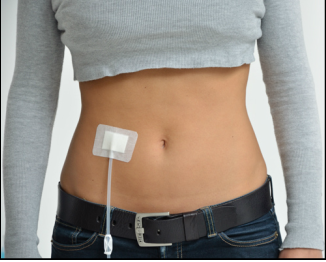
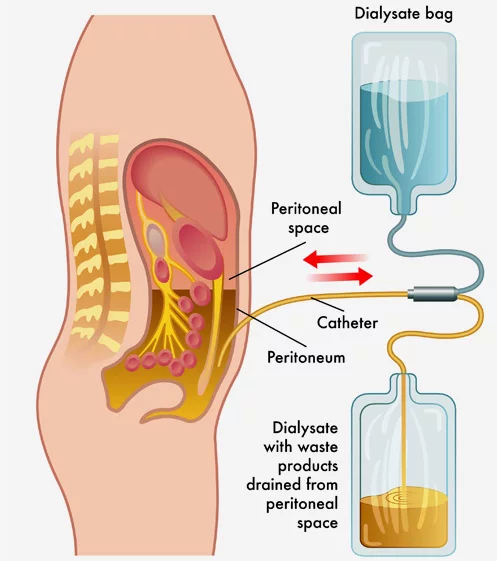
- Continuous ambulatory peritoneal dialysis (CAPD): For this type of blood filtration process a plastic pipe called CAPD catheter is placed inside the abdomen. A specially prepared fluid is then instilled in the abdomen through this plastic pipe. In due course of time exchange of fluid occur between this fluid and blood essentially removing toxins and water. The fluid is drained thereafter and discarded. The pipe remains in the abdomen and the outer part of CAPD catheter is kept clean and covered
What is advantage of having a kidney transplant operation?
With HD, CAPD the clearance of toxins and excess water is not nearly as effective as a normal kidney does. There is a sea of difference in quality of life. Following transplant the individual can lead a productive life. One doesn’t need to visit hospital too often as one requires during HD. The life span of the individual who has received a kidney transplant is more than the patients on HD, CAPD.
How is kidney transplant surgery done?
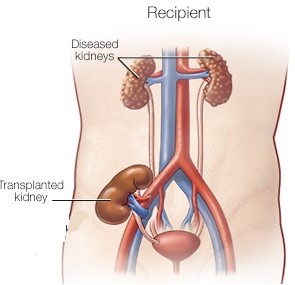
In kidney transplant a 6-7 inches cut is is made usually on right (sometimes left) side of lower abdomen. Through this cut kidney obtained from the donor is placed in the body of the recipient. All the tubes that carry blood into the kidney (artery) and blood (vein) and urine (ureter) out of the kidney are attached to recipient’s tubes. The native kidneys are not removed until there is some compelling reasons to remove them like urinary stones, urine infection etc.
What effect kidney donation has on the donor?
Usually the operation of removal of kidneys from the donors body is done through a key hole surgery. The donor is very carefully selected after ascertaining that the donor will not be affected in any way after kidney donation in future. Usually one kidney if it is functioning well, is sufficient to filter all the blood of the body. Therefore this is a very safe procedure from the point of view of donor safety. The donors can carry on with life, job, child bearing (for female) and can safely forget that they are living with only one kidney
Who can donate kidneys?
The kidney can be donated either by a first degree blood relative of the patient or by a brain dead donor. If the first degree blood relatives are either unfit, unwilling or the blood group doesn’t match, a near relative can also donate his/her kidney.
What if none of my family members is fit for donating kidney?
The longevity of a kidney is best if blood relative donates the kidney as is resembles the native kidney. However, if none of the family member is willing for kidney donation then the only hope is for receiving a kidney from a brain dead donor.
What is a brain dead donor?
A brain dead donor is an individual who has suffered irreversible brain damage due to accident, brain haemorrhage or brain infection. Suppose someone has suffered a severe injury to head in a road accident. He is brought to the hospital where doctors put him on machine for pumping air into body (ventilator), give him injections to keep the heart running but tests show that the brain has already died (There are tests using which doctors can detect this). The breathing is continuing only because ventilator is pumping air into lungs, the heart is beating because of medications. This is an irreversible process. This man is never coming back to life despite the fact that the heart is beating. It is a race against time even for viability of the organs. Ultimately the heart is going to stop if we wait too long. So till the time the heart is beating, and the family of the sufferer understands that the patient is already dead and consents to donate his organs, the kidneys, liver, pancreas, eyes, skin, lungs and heart can be harvested and put into the body of a needy patient.
How can I get organs from a brain dead donor quickly?
The only way to get organs quickly is to pledge your own organs. If no one donates, how is anyone ever going to get organs? Talk about this to your family and register as an organ donor. Tell your family that in unfortunate event of my accident, if I am declared brain dead, kindly donate my organs to needy. Register as donor by visiting www.notto.gov.in. I have encountered a situation in which one patient awaiting kidney transplant from a brain dead donor died in hospital and he himself was declared brain dead. The family of the patient understood the pain of living with failed organs. Since, his kidney were already damaged, the family donated the liver of this patient to another person suffering from liver failure. The life of this patient still continues in body of another person.
Following transplant what precautions do I have to take?
- General precautions for good health like adequate water, healthy food, regular exercise, regular intake of prescribed medications, low salt, no sugar.
- While going to very crowded, dusty places, use a mask.
- Keep the weight under check. After transplant one feels very hungry but the tendency to over eat and put on weight is to be avoided.
- Keep blood pressure in normal range.
- Check the blood sugar, kidney function test and urine test every 3 monthly.
If you are happy with your visit and are getting better please write a review: You can google drsumiturologist or Deetyaclinic: there will be a business page towards right side. Please write a review and help us grow.